

Meta Description
AI workflow design is becoming one of the most valuable skills in 2026. Learn how to build scalable systems, eliminate repetitive work, and move from manual execution to intelligent workflows.
The Way Most People Are Using AI
Most people are still using AI in the simplest way possible. They open a tool, type a prompt, and get an output. In many cases, that alone feels like a huge upgrade. Tasks that once took hours now take minutes, and the efficiency gain is real.
But there’s a limitation hidden in this approach. The interaction starts and ends with a single task. Each time something needs to be done, the process begins again from zero. While the tool is fast, the overall way of working hasn’t fundamentally changed.
That’s why, despite using AI, many people still feel like they are constantly “doing the work.”
The Real Bottleneck Isn’t Speed
The real issue isn’t how fast a task can be completed. It’s how often the same task needs to be repeated.
Take content creation as an example. A founder or marketer might use AI to generate a post, then manually edit it, format it, and publish it across platforms. The output is faster, but the process is still repetitive. The same sequence of actions happens again the next day, and the day after that.
Over time, this repetition becomes the bottleneck. The tool improves speed, but it doesn’t eliminate effort.
That’s where most people stop—and where they miss the bigger opportunity.
The Shift From Tasks to Systems
The real shift begins when the focus moves away from individual tasks and toward the structure behind them.
Instead of asking, “How can I do this faster?” a more useful question is, “Why am I doing this manually every time?”
This is where workflow thinking comes in.
Rather than handling each task separately, the process is designed as a connected sequence. A topic is captured once, an AI system generates a draft, another step refines it, and the final version is automatically scheduled or published. The output may look identical from the outside, but the effort required to produce it is significantly lower.
What changes is not just efficiency, but the entire way work is approached.
What This Approach Actually Means
This approach is not about mastering a specific tool. It is about structuring processes so that multiple steps work together as a system.
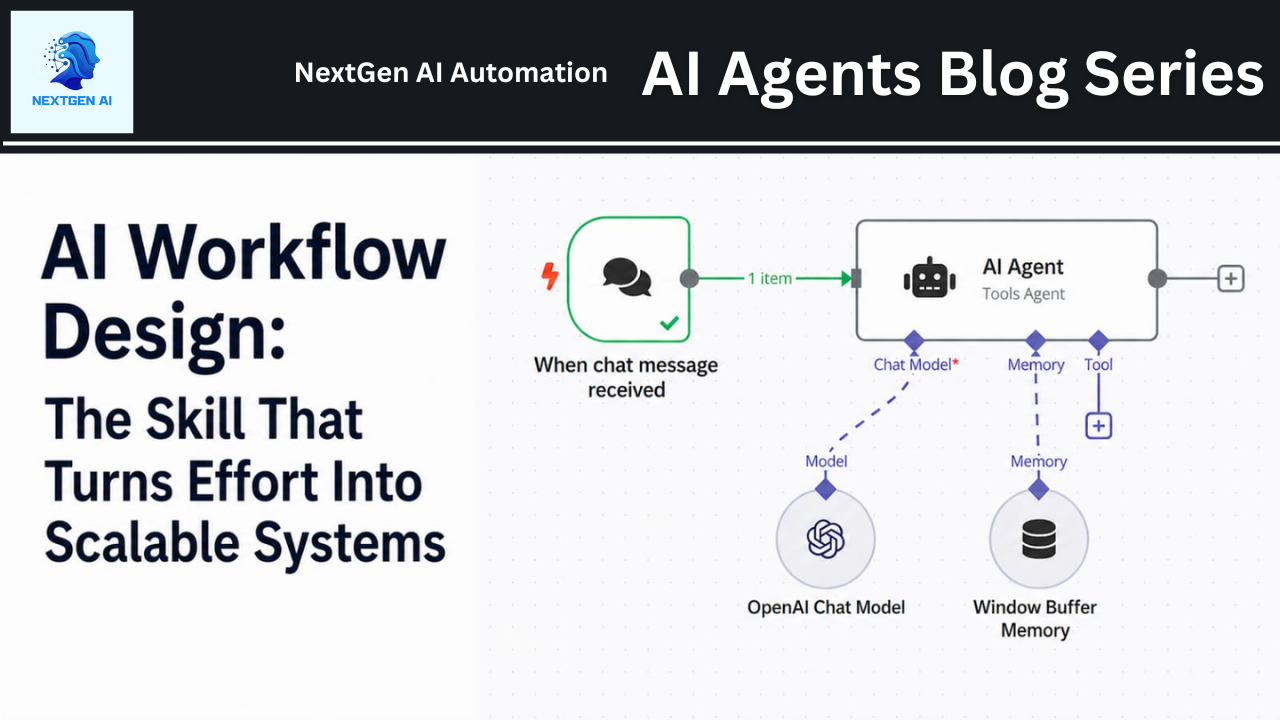
At a basic level, every system follows a simple pattern. Something triggers the process, AI handles the processing, and an action completes it. The important detail is that the system does not stop at generating an output—it carries that output forward into execution.
This is where many early implementations fall short. AI is used to create something, but the responsibility of finishing the task remains manual. The result is partial automation rather than a complete workflow.
True system design closes that gap. For a broader perspective on how AI is shaping modern workflows, you can explore this overview from IBM:
https://www.ibm.com/topics/artificial-intelligence
Why This Shift Is Becoming Critical
As AI becomes more accessible, the difference between simply using it and using it effectively is becoming more visible.
People who rely on task-based usage continue to trade time for output. In contrast, those who design structured systems reduce repeated effort and focus on improving processes instead. Their work becomes more consistent because it follows a defined flow, and their output scales without requiring proportional increases in effort.
This is why workflow thinking is quickly becoming a valuable skill. It doesn’t just improve productivity—it changes how productivity is achieved.
Where This Is Already Happening
This shift is already visible across different types of work.
In content creation, processes are evolving into structured pipelines that handle everything from idea generation to distribution. In marketing, campaigns are increasingly built as interconnected systems where assets are generated, scheduled, and tracked within a single flow. In operations, repetitive tasks such as customer responses and data updates are being handled through automated systems instead of manual effort.
Across all of these areas, the underlying principle is the same: reduce repetition and increase reliability.
The Misconception That Holds People Back
A common question people ask is, “Which AI tool should I learn?”
It seems like a practical place to start, but it often leads to short-term thinking. Tools change quickly, and what is relevant today may not remain so for long.
A more valuable approach is to focus on processes rather than tools. Asking, “What do I keep doing repeatedly that could be automated?” leads to more meaningful improvements. It shifts attention from individual actions to the systems behind them.
That shift is where long-term value is created.
Getting Started Without Overcomplicating It
Starting with this mindset does not require advanced technical skills. It begins with observing your own work.
Identify a task that you repeat regularly and break it down into clear steps. From there, look at which parts can be handled by AI and which can be automated. The next step is to connect those pieces into a simple flow that reduces manual involvement.
The first version does not need to be perfect. What matters is reducing repetition and building a foundation that can be improved over time.
From Execution to Orchestration
AI is not just making work faster. It is changing how work is designed.
In the coming years, the difference will not be between those who use AI and those who do not. It will be between those who continue to operate at the task level and those who build systems that operate independently.
This shift allows individuals and organizations to move beyond manual execution and create processes that function consistently, efficiently, and at scale.
And in a rapidly evolving landscape, that ability is not just useful—it is essential.
Final Thoughts
AI is often introduced as a tool that helps you work faster, but that framing undersells what is really happening. The deeper opportunity is not speed—it is redesign.
The more you observe your own work, the more you start to notice patterns. Tasks repeat. Processes loop. Effort accumulates in places that don’t need it. Choosing to redesign those patterns is what creates long-term leverage.
What makes this shift powerful is that it compounds. A small improvement today becomes a system tomorrow, and over time, those systems begin to handle entire categories of work on their own.
In that sense, this approach is less about technology and more about thinking differently. It is the ability to step back from individual tasks and ask whether the work itself can be structured better.
Those who develop that mindset won’t just use AI more effectively—they will build ways of working that are fundamentally more scalable, resilient, and efficient.
Learn More About Real Workflows
To see how these systems work in real scenarios, explore this guide:
https://blog.nextgenaiautomation.net/?p=454
Community Access
For daily updates, join our WhatsApp community:
https://chat.whatsapp.com/Exap1rUcKbwA9nXQINxdb8?mode=gi_t