

Meta Description:
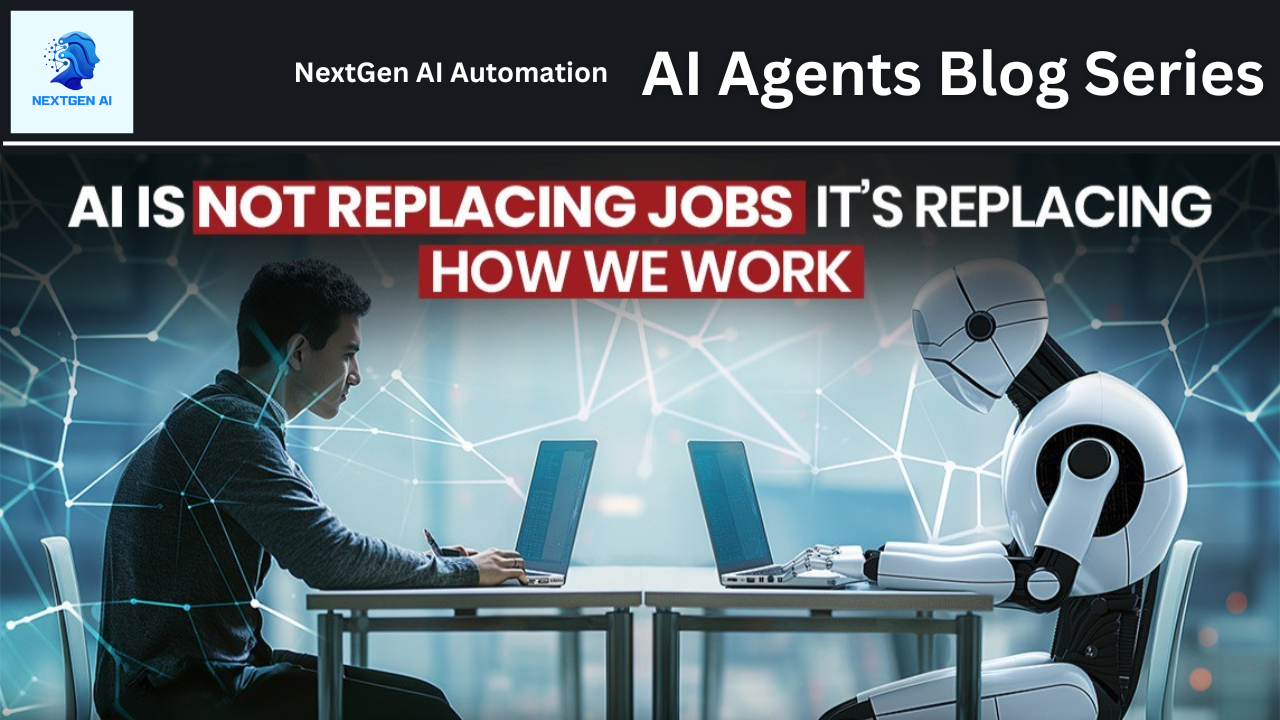
AI is not replacing jobs—it is removing the friction of starting work. This article explores how AI-driven workflows are transforming productivity, redefining professional roles, and shifting human value toward judgment, strategy, and decision-making.
Introduction: The Real Misunderstanding Around AI
Much of the public conversation around AI in the workplace is framed incorrectly.
The dominant narrative suggests that AI is replacing jobs. In reality, the more accurate transformation is far more subtle—and significantly more impactful.
AI is not eliminating work.
It is eliminating friction within work.
Specifically, it is removing the most cognitively expensive phase of any task: starting from zero.
The End of “Starting from Zero”
Historically, professional work followed a predictable pattern:
research → ideation → drafting → refinement → final output
While structured, this process carried a hidden cost. A disproportionate amount of time and cognitive effort was spent not on decision-making, but on generating the initial version of work.
This “blank page problem” created friction across every domain—writing, analysis, planning, and execution.
AI changes this dynamic fundamentally.
Instead of beginning from zero, professionals now begin with a baseline output. The starting point is already generated, allowing human effort to shift toward refinement, evaluation, and strategic improvement.
This represents a structural shift in how work is performed.
From Creation to Curation
The role of the professional is evolving from creator to curator.
In this new model:
- AI generates the initial structure or draft
- Humans evaluate, refine, and contextualize
- Final output is shaped by human judgment and intent
This is not simply a productivity enhancement. It is a redefinition of cognitive allocation.
By removing the need to construct everything from scratch, professionals preserve mental bandwidth for higher-order thinking—strategy, creativity, and decision-making.
The Hidden Benefit: Reduction of Cognitive Friction
The most significant impact of AI is not measurable in output volume, but in reduced cognitive load.
Tasks such as drafting reports, summarizing meetings, or preparing initial outlines are not inherently complex. However, they require activation energy—the psychological barrier to starting.
AI effectively lowers this barrier.
Research in workplace transformation highlights that generative AI is already reshaping how knowledge work is initiated and executed, particularly by accelerating early-stage task generation and reducing manual effort.
https://sloanreview.mit.edu/article/how-ai-is-changing-the-nature-of-work/
At scale, this results in a measurable shift: professionals spend less time initiating work and more time improving it.
Avoiding the Over-Engineering Trap
A common response to AI adoption is the creation of overly complex systems and workflows.
Many professionals attempt to design intricate automations or multi-tool pipelines intended to optimize efficiency. However, in practice, these systems often introduce additional overhead.
The result is a paradox: more time is spent managing systems than producing meaningful output.
Effective AI adoption does not require complexity. It requires usability.
High-performing individuals tend to adopt a simpler mental model:
Can AI generate a functional starting point for this task?
This approach prioritizes execution over system design.
The Rise of the Human-in-the-Loop Model
AI excels at structure, pattern recognition, and rapid generation. However, it lacks contextual understanding, domain judgment, and human nuance.
This creates a clear boundary of responsibility.
The emerging professional model is best described as Human-in-the-Loop (HITL).
In this model:
- AI produces outputs
- Humans evaluate quality and relevance
- Humans determine strategic alignment and correctness
The value of the professional is no longer defined by production volume, but by judgment quality.
AI can generate options. Humans determine direction.
How Workflows Are Actually Changing
Across industries, the structure of work is shifting from linear execution to iterative refinement.
Traditional workflow:
- Start from zero
- Build step by step
- Iterate manually
AI-assisted workflow:
- Generate baseline instantly
- Refine and correct
- Apply human insight and context
This shift is also being recognized at a macroeconomic level, where AI is identified as a major driver of productivity transformation across industries.
https://www.mckinsey.com/capabilities/quantumblack/our-insights/the-economic-potential-of-generative-ai-the-next-productivity-frontier
The implication is clear: value creation is increasingly concentrated in interpretation rather than production.
Practical Adoption Framework
AI integration does not require organizational overhaul. It can begin at the task level.
1. Identify friction-heavy tasks
Locate tasks that require disproportionate effort to begin, not necessarily to complete.
2. Generate initial output using AI
Use AI to create a baseline draft, outline, or structure. The objective is momentum, not perfection.
3. Apply human refinement
Introduce context, accuracy, tone, and strategic alignment. This is where professional value is concentrated.
Over time, this approach compounds into significant productivity gains without structural complexity.
Conclusion: Work Is Becoming More Human, Not Less
Contrary to popular perception, AI is not reducing the human role in work. It is redefining it.
By removing repetitive initiation tasks, AI is allowing professionals to focus on what has always been the most valuable part of work:
- judgment
- strategy
- creativity
- decision-making
- human understanding
The shift is not about replacing workers.
It is about removing unnecessary effort from work.
The result is a workplace that is less mechanical, more cognitive, and increasingly human in its output.
The blank page era is ending. What follows is a model where work begins with momentum, not resistance.
Explore Practical AI Systems
NextGen AI Automation — structured frameworks for real-world AI implementation in business workflows.
https://www.nextgenaiautomation.net/
Community Access
Join discussions on practical AI use cases, workflows, and systems here:
https://chat.whatsapp.com/Exap1rUcKbwA9nXQINxdb8?mode=gi_t